Why Vancouver Is the Best City in North America to Study Games and Animation
Vancouver is home to ILM, EA, Sony Pictures Imageworks, and 60+ studios. Here's why studying game design, game programming, and 3D animation at LaSalle College Vancouver puts you right in front of the action.

With over 60 VFX and animation studios, a $4 billion entertainment economy, and ILM's largest studio in the world just blocks away, Vancouver isn't just a great place to study games and animation. It's where the industry actually lives.
Every games and animation program worldwide promises industry access. Most mean it loosely — a visiting lecturer, a studio tour. In Vancouver, proximity isn't a selling point. It's the building down the street. It's the recruiter who drops into a portfolio review on a Tuesday afternoon. It's the alumni texting back from across town with a referral.
For students pursuing an education in game programming, 3D modeling and animation, game art and design, or VFX, the city you train in shapes the career you enter. Vancouver doesn't just offer a window into the industry. It is the industry.
Vancouver's Entertainment Industry, by the Numbers
Vancouver is the third-largest entertainment production centre in North America, behind only Los Angeles and New York — and the largest single cluster of VFX and animation studios in the world, with more than 60 studios operating across the city. Roughly 99,000 people work in British Columbia's entertainment industry, with the sector projected to contribute $4 billion to the BC economy in 2025.
That growth is accelerating. In January 2025, the BC government raised the Production Services Tax Credit from 28% to 36% — a single policy shift that triggered a measurable hiring surge across the province. Industrial Light & Magic increased its job postings by 168% year over year. DNEG more than doubled its listings. Scanline grew nearly 78%. Sony Pictures Imageworks, already well-established here, increased postings by 13%.
For a student graduating into this market, the timing is unusually good.
The Studios That Define the Ecosystem
The numbers tell part of the story. The studios on the ground tell the rest.
Industrial Light & Magic, the studio behind the visual effects in films and shows a generation of artists grew up watching — opened its Vancouver office in 2012 as a market test. In April 2025, ILM officially opened a new 40,000 square-foot facility at The Stack in downtown Vancouver. It is ILM's largest studio worldwide, employing over 900 people. The Vancouver team has worked on Avatar: Fire and Ash, The Mandalorian, Deadpool & Wolverine, Severance, and Stranger Things.
Sony Pictures Imageworks is relocating its global headquarters to The Post in downtown Vancouver — a decision that quietly signals where the gravitational centre of the VFX world is moving.
EA Vancouver, located in Burnaby, is Electronic Arts' largest and oldest studio. With roughly 1,300 employees and the development team behind EA Sports FC, NHL, and EA Sports UFC, it also houses the world's largest video game testing operation. It has been there since 1983.
Relic Entertainment, the Vancouver-based studio behind Company of Heroes and Warhammer 40,000: Dawn of War — is one of the most respected real-time strategy developers in the world. Kabam develops Marvel Contest of Champions and Disney Mirrorverse from its Vancouver headquarters. Next Level Games makes Nintendo's biggest non-Nintendo titles — Luigi's Mansion 3, Mario Strikers: Battle League — from a studio twenty minutes from LaSalle College Vancouver's campus.
The Coalition (Gears of War), Capcom Vancouver, Hothead Games, East Side Games, 2K, and dozens of indie studios round out an ecosystem that employs artists, programmers, and designers at every level of a career.
What Proximity Actually Does for a Student
Being in Vancouver isn't just about having impressive studio names nearby. It changes the texture of the education itself.
Faculty who still ship
LaSalle College Vancouver's instructors don't teach from memory. Many of them work in the industry now — solving real pipeline problems, shipping titles, consulting on active productions. When a games programming instructor explains how to optimize a render pipeline, they're often describing something they worked through on a project last quarter. That kind of currency doesn't come from a textbook.
Industry guests who actually show up
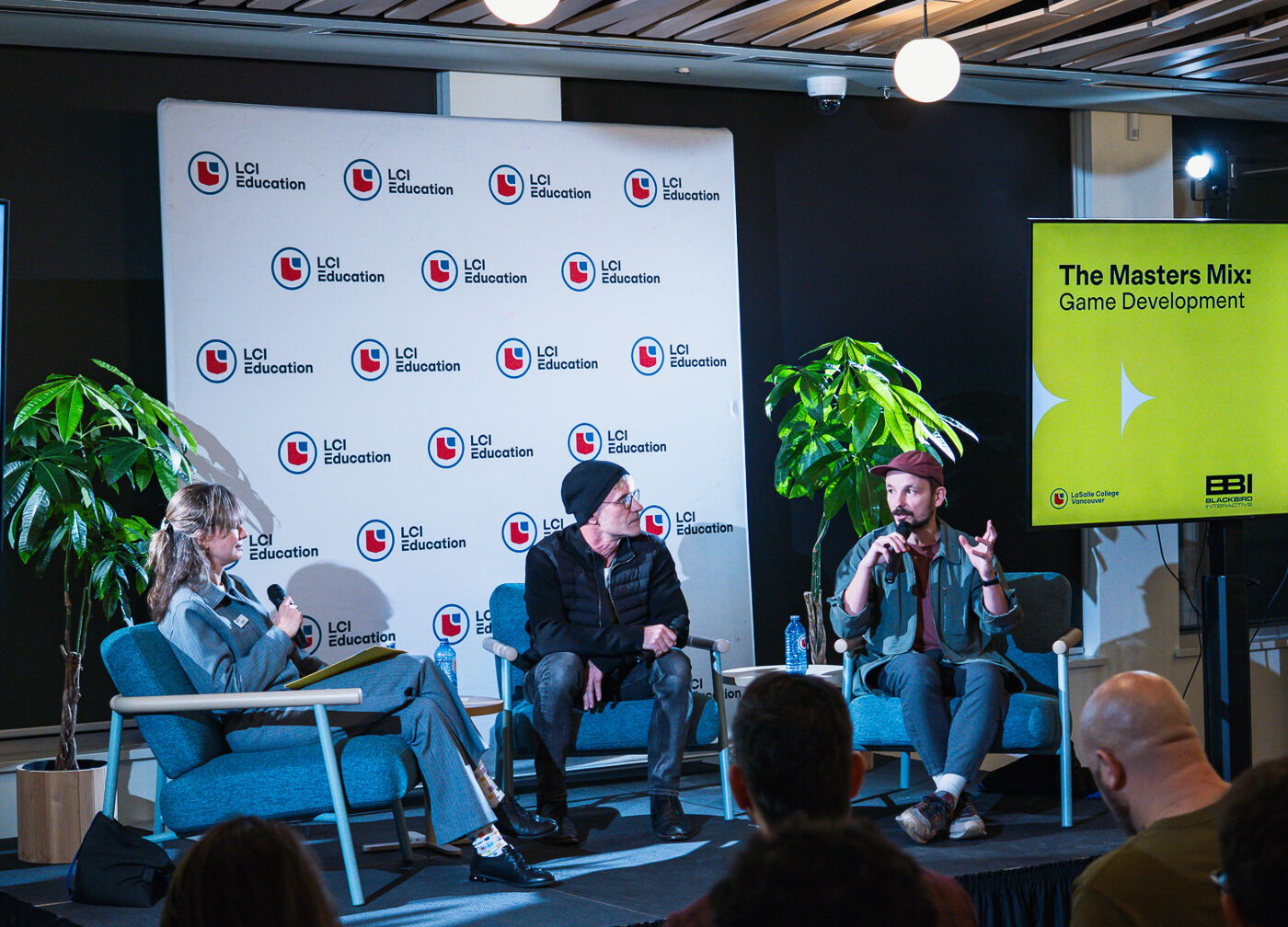
When EA, Relic, ILM, and Sony Imageworks are twenty minutes away, "industry guest" isn't an annual gala event — it's a Tuesday afternoon. Students receive portfolio reviews from professionals who hire from portfolios for a living. The feedback is specific, direct, and tied to what studios are currently looking for.
A peer network that doesn't disperse
In smaller markets, graduating classes scatter at convocation — to Toronto, to Los Angeles, to wherever the work happens to be. In Vancouver, the work is here. The classmate you crammed through a capstone project with is, five years later, a senior artist at a studio you're hoping to join. Ten years out, they're a lead. The relationships don't fade. They compound.
Why This Matters Specifically for Games and Animation
Some creative industries can be entered from anywhere with a strong enough portfolio. Games and animation are not those industries — not in the first years of a career.
The work is deeply collaborative. Pipelines are complex and learned largely by osmosis — by watching experienced practitioners work, making mistakes in a supervised environment, and being corrected in real time. Mentorship happens in hallways and at whiteboards. The first three to five years in these fields are disproportionately shaped by physical proximity to the people doing the work at a high level.
Vancouver lets students build that proximity from year one — through studio visits completed before graduation, through campus reviews with working professionals, and through a cohort that is itself already stepping into the industry.
LaSalle College Vancouver and the Ecosystem
LaSalle College Vancouver's programs in Game Programming, 3D Animation, Game Design, Professional Recording Arts, and Graphic Design are built to connect directly to this ecosystem. Our campus sits in the same creative geography as ILM, the Centre for Digital Media, and dozens of the animation, post-production, and game development studios that define the city's screen-based economy.
Students don't graduate and go looking for the industry. They graduate and walk into it — with a portfolio shaped by real feedback, a peer network already in motion, and the structural advantage that comes from having trained in one of the most concentrated entertainment production environments in the world.
If you're considering a career in games or animation, Vancouver is the place to be. Ranked the #1 Game Design School in Canada for over 10 consecutive years by The Princeton Review, LaSalle College Vancouver offers over 35 creative programs, including programs in Game Design and Programming, 3D Animation, Fashion, Interior Design, Graphic Design, Audio and Film, Information Technology, and Culinary Arts.
Written by Amir Jahanlou, Faculty Lead, Games at LaSalle College Vancouver